

—— Opportunities
Explosive remnants of war
—and beyond.
We are starting with the hardest problem first: detecting ERW in its broadest sense, including landmines and IEDs. One platform. Multiple markets. Designed for the most demanding detection challenges on earth.
A mine warning sign marks contaminated farmland in Ukraine. Photo: Mny-Jhee/iStock
One platform. Multiple markets.
Buried Objects
SSOLAS is designed to find them.
Some buried objects hide where conventional tools cannot reach. SSOLAS is designed to find them. Application-specific configurations will adapt the SSOLAS platform to different operating environments — enabling it to advance infrastructure inspection, construction safety, and broader civilian and industrial needs.
NEAR-TERM PRIORITY
$2.5B → $9B / year, 2024-2032
ERW: Humanitarian & U.S. Military
The global UXO detection services market reached $2.5 billion in 2025, growing at nearly 10% annually, with $9B projected by 2032. Military remediation drives 60% of current revenue; humanitarian demand is the fastest-growing segment.
ADJACENT SEISMIC MARKET
4.7B → $13.5B / year
Geotechnical Instrumentation & Monitoring
Seismic sensing for soil stability, foundation integrity, and slope monitoring. Applies directly to tunnels, dams, and large civil projects — a natural extension of SSOLAS’s core capability.
PLATFORM EXTENSION
$1.4-2.9B / year
Underground Utility Mapping
Damages to underground utilities cost $30 billion annually in the U.S. alone. GPR fails in clay soils and cannot detect non-metallic pipes. SSOLAS detects targets by acoustic contrast — soil-agnostic and effective precisely where dominant technologies fall short.
COMMERCIAL OPPORTUNITY
$300M+ / year
Construction Site Intelligence
Jobsite analytics is one of the fastest-growing segments of a $2.2 trillion industry. Pre-ground-break subsurface clearance for developers, utilities, and port operators is a growing requirement under IIJA mandates and evolving insurance underwriting standards.
Sources: 360iResearch, UXO Detection Service Market (2024); SkyQuesttt, UXO Detection Market Forecast (2032); Fortune Business Insights & Mordor Intelligence, Geotechnical Instrumentation & Monitoring Market (2024); Data Bridge Market Research & Mordor Intelligence, Underground Utility Mapping Market (2024); Business Research Insights, Smart Construction Site Analysis Platforms Market (2024). $16–18B composite TAM is a GoVentures estimate summing four adjacent segments.
The ERW Detection Market
A large market driven by an even larger problem.
Estimating the overall global market for buried ordnance and explosive hazard detection equipment is inherently difficult. Published figures vary by scope and methodology, and do not capture the gap between what the problem demands and what current investment and technology can deliver.
Worldwide ERW Threat
Landmines and ERW contaminate at least 57 countries — killing or injuring 6,279 people in 2024 alone, 86% civilians, nearly half of them children.
Problems in the U.S.
$16.1B+ is the estimated minimum cost to address unexploded ordnance at domestic inactive military ranges — what EPA calls an “imminent and substantial” public health risk.
The Detection Gap
The premise is well-documented. Clearing a minefield today looks much like it did in 1945—people, metal detectors, one careful step at a time.
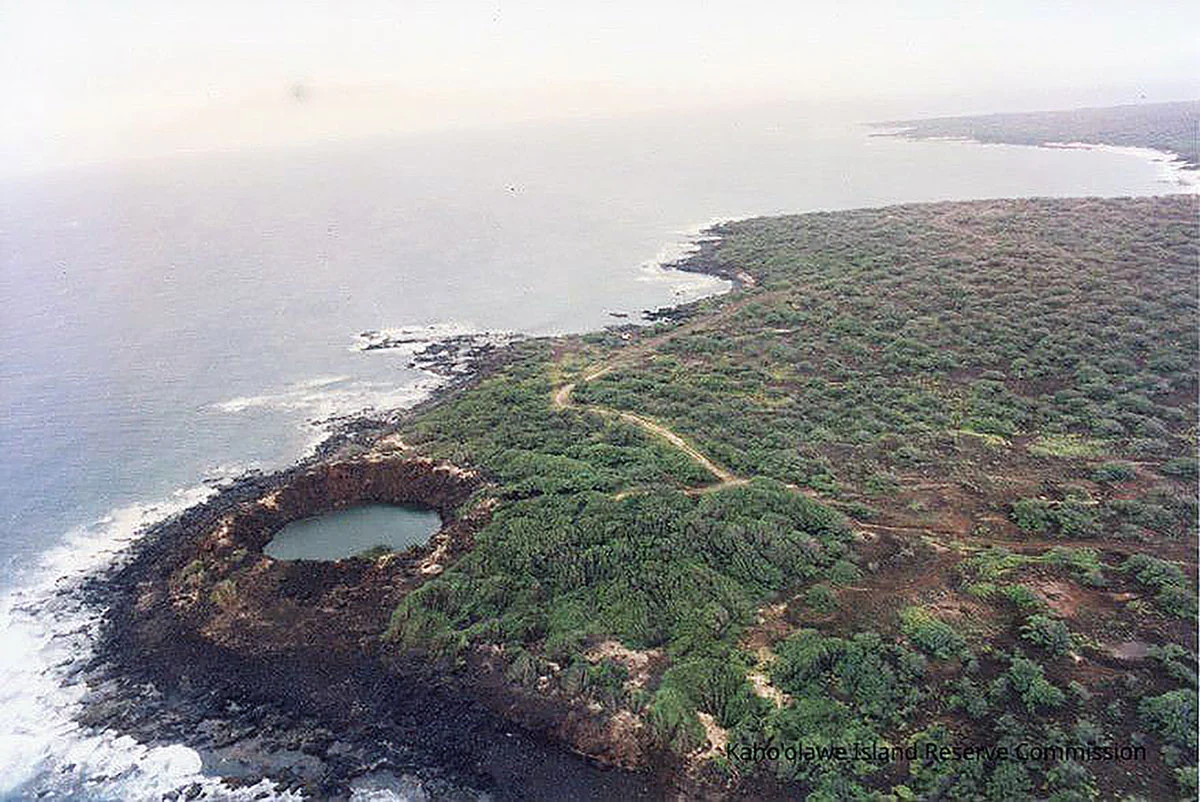
Kahoʻolawe Island, Hawaii, a U.S. Navy target range for decades, is closed to the public due to unexploded ordnance hazards. This crater was formed by three detonations of 454-ton payloads. Photo courtesy of the Kahoʻolawe Island Reserve Commission
Sources: Landmine Monitor 2025, ICBL-CMC; EPA, Cleanups at Federal Facilities: Military Munitions/UXO; Evans & Temple — “The Detection Problem: An Eight-Decade Challenge” Journal of Conventional Weapons Destruction, Vol. 28, No. 1, 2024.
Naming the Threats
ERW, UXO, AXO, IEDs — what SSOLAS targets.
“ERW” is widely used as shorthand for all buried explosive threats — but under international law (CCW Protocol V, 2003), it covers only unexploded and abandoned ordnance, not landmines or IEDs, which fall under separate treaties. The mine action community uses the broader term to capture the full range. So does SSOLAS.
UXO
Unexploded Ordnance
Munitions that were fired or deployed but failed to detonate. Dud rates vary by munition type and conditions — 10–15% is the standard planning estimate for conventional ordnance in conflict zones. For every 1,000 rounds fired, 100 to 150 may remain live in the ground.
Covered under CCW Protocol V (2003)
AXO
Abandoned Ordnance
Munitions that were never fired but left behind — stockpiles, cached weapons, or ordnance abandoned during retreat. Often in unknown locations and condition, making survey particularly critical before any clearance can begin.
Covered under CCW Protocol V (2003)
AP Mines & IEDs
Landmines & Improvised Devices
Antipersonnel and antivehicle mines, plus improvised explosive devices. Technically separate from ERW under the Mine Ban Treaty — but causing the majority of global casualties. SSOLAS addresses these as part of the full buried threat picture.
Mine Ban Treaty (1997) · CCW Protocol II